
The Coal Ministry has issued show-cause to eight firms including Hindalco Industries and Mahanadi Coalfields, and sought explanation from five firms for delays in commencing production from mines allocated to them.

The government on Friday issued fresh show cause notices to prior allottees of coal blocks like JSPL, JSW and Tata Steel, asking reasons behind delays in mines development and warned of deduction in their bank guarantees if they failed to furnish replies.

Oil and Natural Gas Corporation, Hindalco Industries, Tata Steel and Vedanta were down up to 70 per cent below their one-year highs.

The domestic benchmark indices - the S&P BSE Sensex and the National Stock Exchange Nifty50 - had lost close to 1.5 per cent in three days recently before gaining slightly. Notwithstanding weakness and volatility, the Nifty50 has managed to hold on to the 18,000 mark, while the Sensex has managed to stay above the 61,000 level. The performance of the stocks that comprise these front-line indices remains polarised.

Five out of the top 10 companies in Fortune 500 list of Indian companies are from the oil sector.

'Interim Budget has ignited the entrepreneurial spirit.'
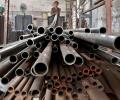
Rising prices of international coal - both coking and thermal - used in the making of ferrous and non-ferrous metals, respectively, are expected to have an impact on margins of metals companies in July-September quarter (Q2) as steel companies may see margins getting eroded, while the base firms could stand to benefit, said brokerages.

Metal and mining companies, such as Tata Steel, JSW Steel, Hindalco, and Coal India, have been among the top-performing sectors on the bourses in recent months. The S&P BSE Metal Index is up 13 per cent in the past three months, rallying 29 per cent in the past year, outperforming the broader market. For comparison, the benchmark S&P BSE Sensex has only seen a 1.7 per cent increase in the past three months, with a 15 per cent gain since the end of September last year.

The hike in clean energy cess is likely to impact input cost for thermal power producers

Tata Steel, others sell assets abroad after taking massive impairments.

Brokerages expect a further slowdown in Indian firms' revenue and earnings growth in Q4FY25, following low single-digit growth in the preceding three quarters, as factors like weak consumer demand and credit growth linger on.

Corporate India is starting to step up its capital expenditure plans amid government incentives and signs of rising demand, company executives and analysts have indicated. This coincides with the Reserve Bank of India (RBI) recently citing a double-digit growth in private capital expenditure. Healthy balance sheets of banks and corporates, along with increasing capacity utilisation and improving business sentiment, are contributing to a favourable environment for sustained growth in private sector investments, the RBI said in its policy last week.

Dividend distribution tax in FY20 would only be applicable after deducting Rs 70 received from the foreign subsidiary, meaning 20.56 per cent DDT would be paid only on Rs 30.

Indian CEOs might like to make some serious course correction.

Short selling, also known as shorting or going short, is the practice of selling assets, usually securities, that have been borrowed from a third party (usually a broker) with the intention of buying identical assets back at a later date to return to the lender.

The S&P BSE Sensex ended down 371 points at 24,966 and the Nifty50 closed 101 points lower at 7,615.

Billionaire Mukesh Ambani's Reliance Industries Ltd climbed eight spots to the 45th rank, the highest for an Indian company on Forbes' latest Global 2000 list of public companies worldwide.

Ajit Mishra answers reader queries on the stock market.

Investors booked profits after strong 641-point rally in the previous two sessions, brokers said.

April-June 2023 (Q1FY24) was a mixed quarter for India's top family-owned business groups. Three of the big five in terms of revenue reported a year-on-year (Y-o-Y) decline in combined net sales and two saw a Y-o-Y fall in net profits. Combined net sales of all listed companies in the five groups were up just 2.2 per cent Y-o-Y at Rs 6.6 trillion in the quarter, down sharply from the 10.3 per cent in the March 2023 quarter (Q4FY23) and 42.8 per cent in Q1FY23.

According to a new survey conducted by consultancy major PriceWaterhouseCoopers, about 28 per cent of Indian financial services firms expect to buy stakes in European groups in the next five years and the same percentage intend to enter North America. "Overseas acquisitions by industrial groups such as Tata Steel, Hindalco, Tata Motors and Ranbaxy are clearly proving inspirational," PwC said in its report.

The index rising for the fourth straight session surged 564 points.

Several Sensex stocks hits 52-week low in intra-day trade on Monday with financials leading the decline.

The FMCG index gained more than 1% on the back of stellar gains in ITC.

Sensex seems to be under pressure on weak cues.

Investors sought to book profits at attractive valuations after recent run up in last few trading sessions.
Together, the top 10 business groups reported a pre-tax loss of Rs 19,342 crore during the January-March 2020 quarter, as against a profit before tax of around Rs 48,500 crore in the year-ago period and Rs 39,600 crore during the December quarter. While Vedanta was the worst hit. others included Aditya Birla, Bharti, Adani, Mahindra, and Tata.

Notwithstanding expectations of a pick-up in construction activity during a seasonally strong January-March quarter (fourth quarter) of 2022-23 (FY23), analysts are cautiously optimistic about the building material sector - encompassing paints, pipes, wood panels, tiles, metals, and cement - as volatile input costs, coupled with fears of a global slowdown, are making demand projections uncertain. Against this backdrop, analysts suggest investors stay selective and pick stocks of companies with stronger brand recall, expanding distribution network, diversified product profile, healthier balance sheet, and sustainable cash flow. "The government's various proposals under Budget 2023-24 (FY24) may lead to the building material segment growing between 8 per cent and 12 per cent for the next five years.

The 30-share Sensex is down 359 points at 26,378 and the Nifty has dropped 78 points to trade at 7,883
Given wild swings, investors are wondering where the metal market is going. There was a strong uptrend in industrial metal through much of the last three years due to fears of supply chain issues - first due to Covid-19 and then due to the Ukraine War. That uptrend broke down as it became apparent that global growth would moderate as inflation rose and Western Europe (the EU plus the UK) went into a near-recession and China was in a rolling lockdown.

The 30-share Sensex ended up 142 points at 29,462 and the 50-share Nifty gained 26 points to end at 8,895.

The S&P BSE Sensex surged 217 points to end at 25,736.

Maruti Suzuki, Asian Paints, L&T, ONGC and Infosys have gained between 1%-1.5%.

From India, Reliance Industries is the only one in the overall top-200 list and is followed by HDFC Bank at 209th, ONGC at 220th, Indian Oil at 288th and HDFC Ltd at 332nd place.

Operating margins have been the primary driver of corporate earnings in India in recent quarters, despite revenue growth suffering from weak consumer demand. Companies across sectors have reported a sharp improvement in earnings before interest, tax, depreciation, and amortisation (Ebitda) margins over the past two years, benefiting from lower commodity and energy prices. Higher margins more than compensated for slower revenue growth, resulting in double-digit growth in net profit for five consecutive quarters.

Among these, Hindalco and Vedanta from the metal pack have become multi-baggers, gaining 100 per cent in 2016

Sensex plunges 322.39 points to over 1-month closing low of 27,797.01; Nifty tumbles 97.55 points to 8,340.70.

India's top listed companies reported their best-ever quarterly net profit of Rs 2.39 trillion in the September quarter of FY22, up 46.4 per cent year-on-year. The earnings were driven by a big surge in the profitability of banks, non-banking financial companies & insurance (BFSI), oil & gas, and metal & mining firms. The combined net profit of these three cyclical sectors were up 87 per cent YoY to a record high of Rs 1.53 trillion, up from Rs 82,000 crore a year ago and Rs 1.08 trillion in Q1FY22.

Sensex, Nifty put up a good show in closing trade.
 © 2026 Rediff.com - Advertise with us - Disclaimer - Privacy Policy - Sitemap - Feedback - About us - Terms of use - Grievances